 By blogziro123@gmail.com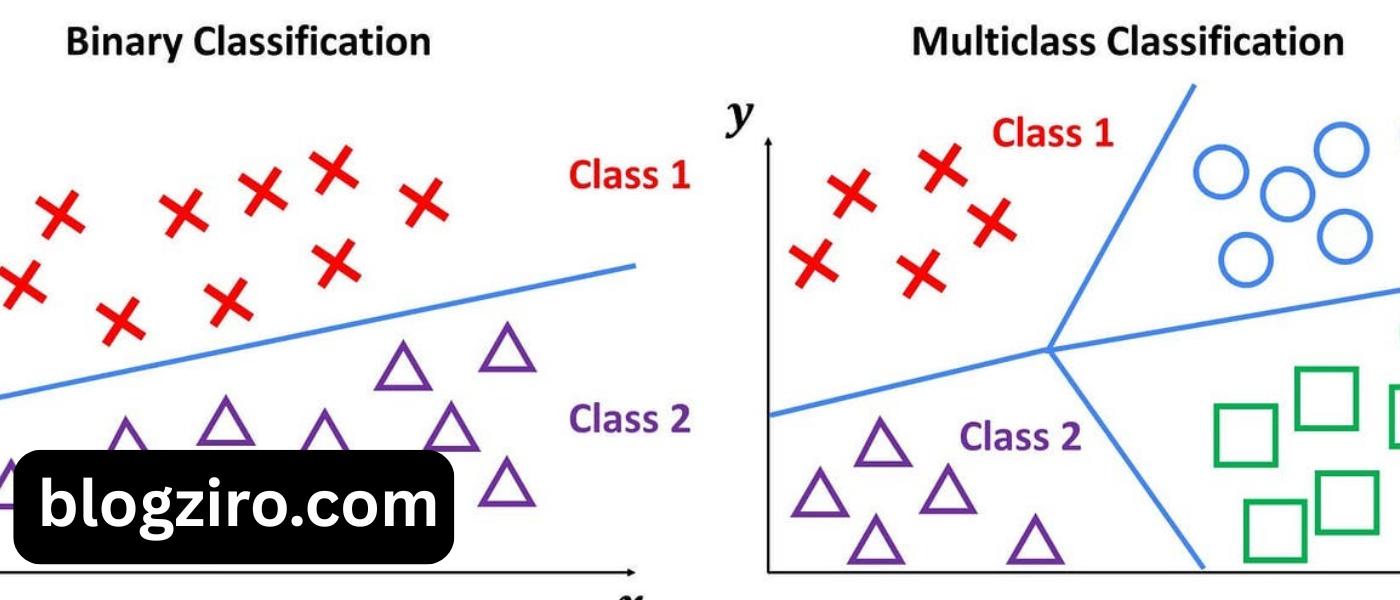
Meta description:
Multiclass Logistic Regression with simple explanations, soft max intuition, training steps, and real-world examples. Includes tips, metrics, and FAQs.
Introduction
You’ve got a problem with more than two labels. Not just “spam vs not spam,” but “spam, promotions, social, updates.” Not “cat vs dog,” but “cat, dog, horse, rabbit.” This is exactly where multiclass logistic regression shines.
It’s one of the most useful “first serious” machine learning models. It’s fast, interpretable, and often surprisingly strong when your features are decent. If you’re learning ML, you’ll see it everywhere—text classification, image baselines, customer segmentation, medical triage, and more.
In this guide, you’ll learn what multiclass logistic regression is, how it works (without heavy math), when to use it, how to train it, how to evaluate it, and what mistakes to avoid—so you can actually apply it with confidence.
What Is Multiclass Logistic Regression?
Multiclass logistic regression is a classification model used when the target has three or more classes.
-
Binary logistic regression predicts: Class 0 or Class 1
-
Multiclass logistic regression predicts: Class A, Class B, Class C, …
Instead of outputting one probability, it outputs a probability for each class, then selects the class with the highest probability.
A quick example
Imagine you’re predicting a user’s support request category:
-
Billing
-
Technical Issue
-
Account Access
Your model looks at the input (words, counts, features) and returns something like:
-
Billing: 0.10
-
Technical Issue: 0.75
-
Account Access: 0.15
Prediction: Technical Issue.
How Multiclass Logistic Regression Works (Soft max Intuition)
Multiclass logistic regression usually uses something called the soft max function. You don’t need to memorize the formula to understand the idea:
-
The model computes a score for each class.
-
Soft max turns those scores into probabilities that add up to 1.
-
The highest probability becomes the prediction.
What creates the “score”?
Each class has its own set of weights. The model learns which features push the prediction toward which class.
For example, in text classification:
-
Words like “refund,” “invoice,” “charged” may increase the Billing score.
-
Words like “error,” “bug,” “crash” may increase the Technical Issue score.
That’s why logistic regression can be quite interpretable: you can inspect which features influence each class.
Two Main Approaches: Soft max vs One-vs-Rest
There are two common ways to do multiclass logistic regression:
1) Soft max (Multinomial Logistic Regression)
-
Trains one model that handles all classes at once.
-
Produces a clean probability distribution across classes.
-
Commonly used and usually preferred.
2) One-vs-Rest (OvR)
-
Trains one binary model per class.
-
Each model learns “Is it this class or not?”
-
Then you pick the class with the highest confidence score.
Which should you choose?
-
If you have a standard ML library option: start with multinomial/soft max.
-
OvR can be useful when classes behave very differently or when you want simpler per-class models.
When Should You Use Multiclass Logistic Regression?
Multiclass logistic regression is a great choice when:
-
You need a strong baseline quickly
-
Your dataset is medium to large
-
You want interpretability (feature importance per class)
-
The relationship between features and classes is roughly linear
-
You’re working with high-dimensional sparse features (like TF-IDF text vectors)
Common real-world uses
-
News category classification: sports, politics, business, tech
-
Customer support routing
-
Sentiment rating: negative, neutral, positive
-
Product type prediction in ecommerce
-
Simple image classification (as a baseline with extracted features)
Data Requirements and Feature Prep
Good input features matter more than fancy models. Here’s what to focus on.
1) Clean labels
Make sure your labels are consistent. Avoid:
-
duplicate names (“Tech Issue” vs “Technical Issue”)
-
too many rare categories with only a handful of samples
2) Numeric features
Logistic regression needs numbers. You can use:
-
standard numeric features (age, price, counts)
-
one-hot encoding for categories (city, device type)
-
TF-IDF or bag-of-words for text
3) Feature scaling (often helpful)
For many implementations, scaling numeric features improves training:
-
Standardization (mean 0, variance 1) is common.
Training Objective in Plain English
Multiclass logistic regression learns weights that make the correct class probability as high as possible.
It does this by minimizing a loss called cross-entropy loss (also known as log loss). In simple terms:
-
If the model is confident and correct → small loss
-
If the model is confident and wrong → big loss
-
If the model is unsure → medium loss
Regularization: controlling overfitting
Most logistic regression models include regularization:
-
L2 regularization (Ridge): smooth, common default
-
L1 regularization (Lasso): can shrink some weights to zero (feature selection)
Regularization is especially important in:
-
high-dimensional data (like text)
-
small datasets
A Practical Example You Can Picture
Let’s say you want to classify short messages into:
-
Work
-
Personal
-
Spam
Your features might include:
-
presence of keywords (“meeting”, “project”, “sale”, “discount”)
-
number of links
-
message length
-
sender domain reputation
Over time, the model learns patterns like:
-
Links + discount words → Spam
-
“meeting” + “deadline” → Work
-
“dinner” + “family” → Personal
This is the core value: the model turns your feature signals into class probabilities.
How to Evaluate a Multiclass Model Properly
Accuracy alone can lie, especially with class imbalance. Use multiple metrics.
Key metrics (and why they matter)
-
Accuracy: overall correctness (good baseline)
-
Precision & Recall (per class): tells you what you’re missing and mislabeling
-
F1-score: balances precision and recall
-
Confusion matrix: shows which classes get confused with each other
-
Log loss: evaluates probability quality, not just final labels
Macro vs weighted averages
When classes are imbalanced:
-
Macro average treats each class equally (great for fairness across classes)
-
Weighted average accounts for class frequency (good for overall performance)
Common Problems and How to Fix Them
Problem 1: Class imbalance
If one class dominates, the model may “play it safe.”
Fixes:
-
Use class weights
-
Collect more data for minority classes
-
Use better metrics (macro F1)
Problem 2: Overlapping classes
Some classes are naturally confusing.
Fixes:
-
Improve features (more signals)
-
Merge labels if they’re not truly distinct
-
Consider hierarchical labeling (general → specific)
Problem 3: Underfitting (model too simple)
Logistic regression draws linear boundaries. Some problems are non-linear.
Fixes:
-
Add interaction features
-
Use polynomial features carefully
-
Try a stronger model (tree-based methods, neural networks) after you have a good baseline
Best Practices for Real Projects
Keep it simple, but systematic
-
Start with a clear baseline
-
Improve data quality and features before switching models
-
Track metrics over time
A quick multiclass checklist
-
✅ Clean labels and enough examples per class
-
✅ One-hot / TF-IDF / scaled numeric features
-
✅ Regularization enabled
-
✅ Proper train/validation split
-
✅ Confusion matrix review
-
✅ Macro F1 if imbalance exists
Key Takeaways
-
Multiclass logistic regression predicts one of 3+ classes using probabilities.
-
The most common version uses soft max (multinomial) for clean multi-class probability output.
-
It’s fast, strong, and interpretable—excellent as a first model and often good enough for production.
-
Use more than accuracy: focus on macro F1, confusion matrix, and log loss.
-
Most performance gains come from better features and cleaner labels, not fancy tricks.
People Also Ask: FAQs (6)
1) What is the difference between multiclass logistic regression and soft max regression?
They usually mean the same thing. Soft max regression is the common implementation of multiclass logistic regression, where soft max converts class scores into probabilities.
2) Is multiclass logistic regression linear or non-linear?
It is linear in the feature space. It can’t naturally model complex non-linear boundaries unless you engineer features (like interactions or polynomial terms).
3) When should I use one-vs-rest instead of soft max?
Use one-vs-rest when you want a separate classifier per class, or when you suspect each class has very different patterns. Otherwise, softmax/multinomial is often the clean default.
4) Can multiclass logistic regression handle text classification well?
Yes—especially with TF-IDF features. Logistic regression is a classic choice for text problems because it works well with sparse, high-dimensional data.
5) What metrics are best for multiclass logistic regression?
Use accuracy as a quick check, but rely on macro F1, per-class precision/recall, and a confusion matrix to understand real performance—especially when classes are imbalanced.
6) How do I prevent overfitting in multiclass logistic regression?
Use regularization (L2 or L1), avoid too many noisy features, and validate with a proper split. In text problems, regularization is essential.
Conclusion
Multiclass logistic regression is one of the most practical models you can learn and use. It’s simple enough to understand, fast enough to train, and strong enough to solve many real problems—especially when your data and features are well-prepared.
If you’re building an ML skill set or creating reliable baselines for projects, start here. Get your labels clean, craft meaningful features, evaluate beyond accuracy, and you’ll have a model that’s not just “working,” but genuinely useful.
If you want, share your dataset type (text, tabular, images-with-features) and number of classes, and I’ll suggest the best feature setup and evaluation plan for multiclass logistic regression on your exact case.